A beautiful smile can completely change the way you look and feel. Whether you want to improve your confidence, look better in photos, or prepare for an important event like a wedding or job interview, cosmetic dentistry offers several solutions to enhance your smile.
Two of the most popular smile makeover treatments today are teeth whitening and dental veneers. While both can improve the appearance of your teeth, they work in very different ways and are meant for different dental concerns.
In this blog, we’ll explain what veneers and whitening are, their benefits, differences, and which treatment suits your needs. We’ll also include FAQs to clear common doubts.
Why Do People Choose Smile Makeover Treatments?
Over time, teeth can become stained, chipped, worn out, or uneven. Some people naturally have teeth that are darker in shade. Others may have gaps, irregular shapes, or mild misalignment that affects their smile.
Common reasons people seek cosmetic dental treatments include:
- Yellow or stained teeth from tea, coffee, or smoking
- Uneven or chipped front teeth
- Small gaps between teeth
- Worn-out tooth edges due to grinding
- Discoloration that doesn’t improve with brushing
- Lack of confidence while smiling
The right treatment depends on whether your concern is only tooth color or if you also want to improve shape, size, and alignment.
What Is Teeth Whitening?
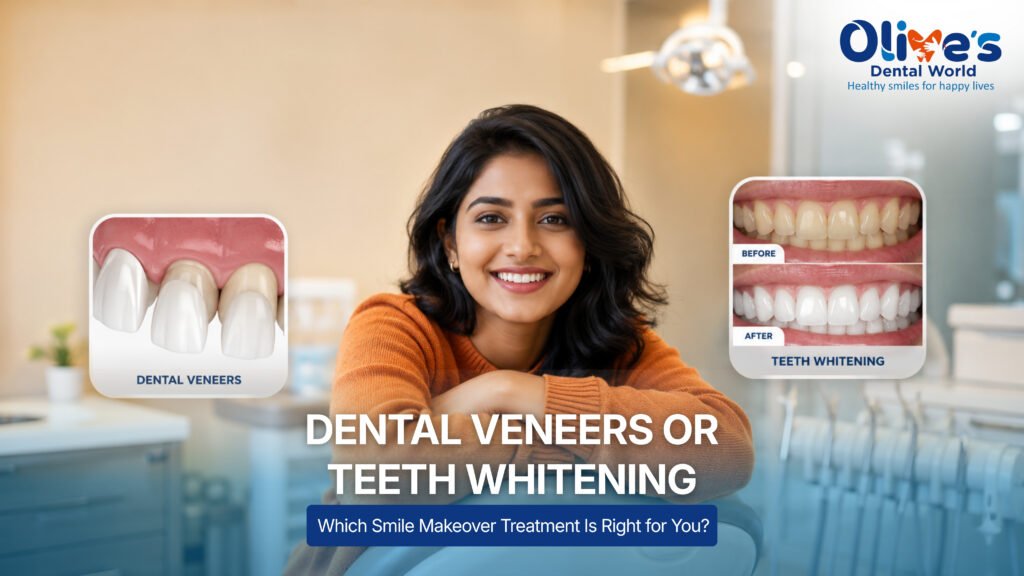
Teeth whitening is a cosmetic dental procedure that lightens the shade of natural teeth using professional whitening agents. It removes stains from the enamel and improves overall brightness.
Whitening is a great option for people whose teeth have become yellow due to:
- Coffee and tea
- Smoking and tobacco use
- Certain foods and spices
- Aging and enamel thinning
- Poor oral hygiene habits
Types of Teeth Whitening
1. In-Office Whitening (Professional Whitening)
This is done by a dentist using high-strength whitening gel. Results are usually visible in a single session.
2. Dentist-Supervised Home Whitening
Custom trays and whitening gel are provided for use at home over a few days or weeks.
Both methods are safe when done under dental supervision.
Benefits of Teeth Whitening
Teeth whitening is one of the most preferred cosmetic dental procedures because it is quick and simple.
1. Fast Results
In-office whitening can brighten teeth by several shades in just 45 to 90 minutes.
2. Non-Invasive Treatment
No drilling or cutting is required. Your natural tooth structure remains unchanged.
3. Affordable Smile Enhancement
Compared to veneers, whitening is budget-friendly and offers noticeable improvement.
4. Natural-Looking Smile
Whitening keeps your natural tooth shape, giving a realistic and refreshed appearance.
Limitations of Teeth Whitening
Although whitening is effective for many people, it does not work in every case.
1. Not Effective for Deep Internal Stains
Some stains are inside the tooth and cannot be removed by whitening, such as:
- Fluorosis stains
- Tetracycline discoloration
- Tooth discoloration after trauma
2. Results Are Not Permanent
Whitening results typically last 6 months to 2 years, depending on lifestyle habits.
3. Temporary Tooth Sensitivity
Some people experience mild sensitivity for a few days after whitening, especially if they already have sensitive teeth.
4. Whitening Cannot Fix Tooth Shape Problems
Whitening does not correct:
- chips
- gaps
- uneven teeth
- crooked teeth
If you want more than color correction, veneers may be a better option.
What Are Dental Veneers?
Dental veneers are thin, custom-made shells placed on the front surface of teeth to improve their appearance. Veneers can enhance the smile by changing the color, shape, size, and alignment of teeth.
They are commonly used in complete smile makeover treatments because they cover multiple cosmetic concerns at once.
Types of Veneers
1. Porcelain Veneers
These are strong, long-lasting, and highly stain-resistant. They look extremely natural because porcelain reflects light like natural enamel.
2. Composite Veneers
These are made from tooth-colored resin material. They are less expensive and can often be completed faster, but they may stain over time and may not last as long as porcelain.
Benefits of Dental Veneers
Veneers are considered a premium cosmetic dentistry option because of their dramatic and long-lasting results.
1. Complete Smile Transformation
Veneers can fix multiple issues at once, including:
- dark stains
- chipped teeth
- worn teeth
- gaps between teeth
- uneven or irregular tooth shape
- mild crookedness
2. Long-Lasting Results
Porcelain veneers can last 10 to 15 years or more with proper care.
3. Stain Resistance
Porcelain veneers resist staining from tea, coffee, and smoking much better than natural teeth.
4. Custom Smile Design
Veneers are designed according to your face shape and smile line, helping create a more symmetrical and attractive smile.
5. Ideal for Teeth That Don’t Whiten
If your teeth have deep discoloration that does not respond to whitening, veneers are an excellent solution.
Limitations of Dental Veneers
Even though veneers offer impressive results, they may not be suitable for everyone.
1. Higher Cost
Veneers are more expensive because they are custom-made and require multiple visits.
2. Tooth Preparation Required
Porcelain veneers usually require removing a small amount of enamel. This means the procedure is not fully reversible.
3. Risk of Damage if Misused
Although strong, veneers can chip or crack if you bite very hard foods, chew ice, or grind your teeth.
4. Not Suitable for Untreated Dental Problems
If you have gum disease, tooth decay, or severe bite issues, these problems must be treated first before placing veneers.
Veneers vs Teeth Whitening: Key Differences
Here’s a simple comparison:
Teeth Whitening
- Improves tooth color only
- Non-invasive and safe
- Affordable
- Results last months to a few years
- Best for mild to moderate staining
Dental Veneers
- Improves color, shape, and alignment
- Requires minor enamel trimming
- Higher cost
- Results last 10–15 years
- Best for complete smile makeovers
When Teeth Whitening Is the Right Choice
Teeth whitening is ideal if:
- Your teeth are healthy and well-shaped
- Your main concern is yellow staining
- You want a quick improvement for an event
- You prefer a non-invasive cosmetic option
- You want a cost-effective smile upgrade
Whitening is often the first treatment recommended for patients who want a brighter smile without changing tooth structure.
When Veneers Are the Better Option
Veneers may be the right choice if:
- You have deep stains that whitening cannot remove
- Your teeth are chipped, uneven, or worn down
- You want to close small gaps
- You want a symmetrical “perfect smile”
- You want long-lasting results
- You want a full smile makeover instead of only whitening
Can You Combine Whitening and Veneers?
Yes. Many dentists recommend combining both for the best outcome.
For example:
- Whitening may be done for natural teeth
- Veneers may be placed only on teeth that are chipped, uneven, or severely stained
FAQs: Dental Veneers vs Teeth Whitening
1. Which treatment gives faster results?
Teeth whitening gives faster results, often in a single appointment. Veneers usually take 2–3 visits.
2. Are veneers better than whitening?
Veneers are better for complete smile correction, while whitening is better if your only concern is tooth color.
3. Can veneers be whitened later?
No. Veneers do not respond to whitening agents. If you want a brighter smile, veneers must be replaced.
4. Is teeth whitening safe?
Yes, professional whitening performed by a dentist is safe and does not damage teeth.
5. Do veneers damage natural teeth?
Veneers require minor enamel removal, but when done correctly, they are safe and do not harm the tooth.
6. How long does teeth whitening last?
Whitening results can last 6 months to 2 years depending on diet and oral habits.
7. How long do veneers last?
Porcelain veneers can last 10–15 years or more, while composite veneers last around 4–7 years.
8. Which is more expensive: veneers or whitening?
Veneers are more expensive because they are custom-designed and long-lasting. Whitening is more affordable.
9. Can I get veneers for one tooth only?
Yes. Veneers can be placed on a single tooth or multiple teeth depending on the cosmetic requirement.
10. Which option is best for wedding smile makeovers?
Whitening is best for quick improvement, but veneers are best if you want a complete, flawless transformation.
Which Smile Makeover Treatment Is Best for You?
Both veneers and teeth whitening are excellent options, but the best choice depends on your smile goals.If you want a simple improvement and your teeth are healthy, teeth whitening is the easiest and most affordable solution.
If you want a dramatic transformation that improves color, shape, and symmetry, dental veneers are the best option.The right treatment can only be confirmed after a dental consultation where your dentist checks tooth health, enamel condition, and your desired results.
Book your consultation: +91 954 20 32 323
visit our website: https://olivesdentalworld.com/about/