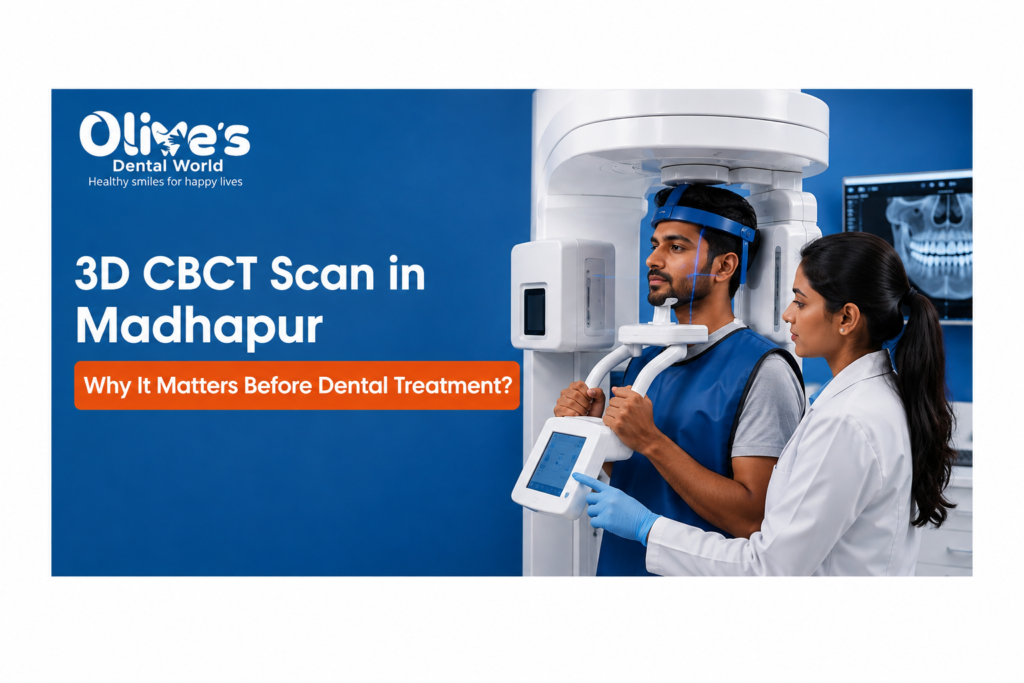
Dental treatment is not always as simple as examining the teeth and taking a conventional dental X-ray. In many cases, dentists need a detailed view of the teeth, jawbone, nerves, sinuses, and surrounding structures before deciding on the right treatment. This is where a 3D CBCT scan in Madhapur can play an important role.
CBCT, or Cone Beam Computed Tomography, is an advanced dental imaging technology that creates detailed three-dimensional images of the oral and maxillofacial region. It can help dentists understand the underlying anatomy more clearly and plan certain dental procedures with greater precision.
What Is a 3D CBCT Scan?
A CBCT scan uses a cone-shaped X-ray beam to capture multiple images from different angles. These images are processed to create a three-dimensional view of the teeth, jawbone, nerves, and surrounding structures.
Unlike a traditional two-dimensional dental X-ray, CBCT provides views from different directions, allowing the dentist to examine areas that may not be clearly visible in standard imaging.
Depending on the treatment, a CBCT scan may help assess:
- Tooth roots and their position
- Jawbone density and structure
- Impacted wisdom teeth
- The location of important nerves
- Sinus structures
- Bone loss around teeth
- Dental implant sites
- Root canal anatomy
- Jaw and facial structures
Why Is CBCT Important Before Dental Treatment?
1. Helps With Accurate Treatment Planning
Before certain complex dental procedures, your dentist may need more information than a conventional X-ray can provide. A 3D CBCT scan gives a more detailed picture of the treatment area, helping the dentist evaluate the anatomy before proceeding.
This can be particularly useful for dental implants, complicated root canal procedures, wisdom tooth removal, and certain orthodontic treatments.
2. Provides a 3D View of the Jaw and Teeth
One of the biggest advantages of CBCT is that it provides three-dimensional information. The dentist can examine the treatment area from different angles instead of relying only on a flat image.
This can make it easier to understand the position of teeth, roots, bone structures, and other anatomical features.
3. Useful for Dental Implant Planning
Dental implants require careful evaluation of the jawbone. The dentist needs to understand the available bone and the position of nearby anatomical structures.
A CBCT scan can provide information that helps with implant planning, including the height and width of the bone and the relationship between the proposed implant site and important structures.
4. Helps Assess Impacted Wisdom Teeth
Wisdom teeth can sometimes grow at unusual angles or remain partially or completely impacted. Their roots may also be close to important nerves.
A CBCT scan can help the dentist understand the three-dimensional position of an impacted tooth and its relationship with nearby structures before recommending extraction.
5. Supports Complex Root Canal Treatment
Root canals involve treating the internal structure of a tooth. In complicated cases, additional imaging may be recommended to identify unusual root anatomy, curved canals, infections, or other structures that may not be clearly visible on conventional X-rays.
CBCT can provide valuable information when a dentist needs a more detailed assessment.
6. Helps Evaluate Jawbone and Dental Problems
CBCT imaging may also help identify bone-related changes, certain infections, cysts, lesions, or other abnormalities that require further evaluation.
However, CBCT should be prescribed based on the patient’s individual dental needs rather than being used routinely for every dental examination.
When Might Your Dentist Recommend a CBCT Scan?
A dentist may recommend a CBCT scan when detailed three-dimensional information is needed for diagnosis or treatment planning.
Common situations include:
- Dental implant planning
- Complex wisdom tooth extraction
- Complicated root canal cases
- Orthodontic treatment planning
- Evaluation of impacted teeth
- Assessment of jawbone structure
- Certain oral surgery procedures
- Evaluation of complex dental infections
- Examination of the relationship between teeth and nerves
Your dentist will determine whether CBCT is appropriate based on your symptoms, dental history, examination, and planned treatment.
Is a CBCT Scan the Same as a Dental X-Ray?
No. Both use X-rays, but they provide different types of information.
A conventional dental X-ray generally produces a two-dimensional image, while CBCT creates a three-dimensional representation of the scanned region.
CBCT may therefore be useful when a dentist needs more detailed information about the depth, position, or relationship between different anatomical structures.
However, because CBCT involves radiation exposure, it should be used when the additional information is expected to benefit the diagnosis or treatment plan.
What Happens During a CBCT Scan?
The procedure is generally quick and non-invasive.
During the scan:
- You may be asked to remove metal objects such as jewellery or glasses.
- You will be positioned appropriately in the CBCT machine.
- Your head will be stabilized to minimize movement.
- The scanner will rotate around the head while capturing images.
- The images will be processed into a three-dimensional digital view.
- Your dentist or oral healthcare professional will review the images and use them for diagnosis or treatment planning.
You typically do not feel anything during the scan.
Is 3D CBCT Safe?
CBCT uses ionizing radiation, so it should not be performed unnecessarily. Modern dental CBCT systems can use relatively low radiation doses compared with conventional medical CT, although the actual exposure varies according to the machine, scan area, and imaging settings.
Your dentist should recommend CBCT when the expected diagnostic or treatment-planning benefits outweigh the potential risks.
If you are pregnant or think you may be pregnant, inform your dentist before any X-ray-based imaging.
How Can CBCT Improve Dental Treatment Planning?
The main benefit of CBCT is additional three-dimensional information. Having a clearer understanding of the anatomy can help dentists plan procedures more carefully.
For example, before an implant procedure, the dentist can evaluate the proposed implant location and surrounding bone. Before removing an impacted wisdom tooth, the dentist can assess its position relative to nearby structures.
This detailed information can contribute to a more individualized treatment plan.
Who Should Consider a 3D CBCT Scan in Madhapur?
Not every dental patient needs a CBCT scan. It is generally considered when conventional examination or standard X-rays do not provide enough information for a particular dental problem.
If you are planning:
- Dental implants
- Wisdom tooth removal
- Complex root canal treatment
- Orthodontic treatment
- Oral surgery
- Treatment involving impacted teeth
your dentist may recommend CBCT as part of the diagnostic process.
What Should You Ask Your Dentist Before a CBCT Scan?
Before undergoing the scan, you can ask:
- Why is a CBCT scan needed for my treatment?
- What information will the scan provide?
- Can a conventional X-ray provide enough information?
- What area will be scanned?
- How will the scan affect my treatment plan?
- Are there any precautions I should take?
Understanding why the scan is recommended can help you feel more comfortable with the diagnostic process.
Frequently Asked Questions
1. Is CBCT required before every dental treatment?
No. CBCT is generally recommended when detailed three-dimensional information is needed and a regular dental X-ray is not sufficient.
2. How long does a dental CBCT scan take?
The actual scan is usually completed within a short period, although the exact time depends on the machine and the area being scanned.
3. Is CBCT painful?
No. CBCT is a non-invasive imaging procedure and does not normally cause pain.
4. Is CBCT useful before dental implants?
Yes. CBCT can provide detailed information about the jawbone and nearby anatomical structures, which can be useful for implant planning.
5. Can children have a CBCT scan?
CBCT may be used in children when clinically justified. The dentist should consider whether the scan is necessary and use appropriate imaging settings.
Get the Right Dental Diagnosis with 3D CBCT Scanning in Madhapur
A 3D CBCT scan in Madhapur can provide valuable three-dimensional information when detailed dental imaging is necessary. From implant planning and impacted wisdom teeth to complex root canal procedures and orthodontic assessment, CBCT can help dentists visualize anatomical structures more clearly before treatment.
However, CBCT is not required for every dental problem. The decision should be based on your individual condition and the type of treatment being considered. If your dentist recommends a CBCT scan, discussing its purpose and benefits can help you understand how it contributes to your treatment plan.
Book your consultation: +91 954 20 32 323
visit our website: https://olivesdentalworld.com/about/